DNA, Chromosomes and Genes
These three terms are closely related. The DNA is the smallest of those three. It's the biochemical that forms the genes. The genes, which give instructions to a cell to produce a particular protein, form the chromosomes. They are found in the nucleus of the cell.The chromosomes hold our entire genetic material and express a specific phenotype. Each human cell has 23 pairs of chromosomes which gives a total of 46. Half of them come from the father, the other half from the mother. To produce a healthy individuum, the genes must work perfetcly together. Even small mutations can cause major syndromes. One example for mutation is the Huntington's Disease. It is caused by a mutation on the HTT gene. It affects the production of the protein huntington which appears to play an important role in nerve cells in the brain. Symptoms of the disease are uncontrolled movements, emotional problems and loss of thinking ability.
Meiosis
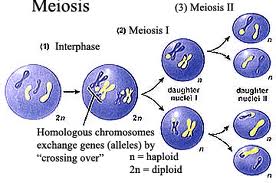
As I said earlier, every human has 23 pairs of chromosomes, half from the father and the other half from the mother. The number of chromosomes in human cells stays constantly at 23, which means that the cells in mum and dad must cut their chromosome pairs in half so that the child again has 23 pairs. This process is called meiosis. During the process specific cells, the germline cells,. divide. Meiosis is divided into Meiosis I and Meiosis II, which again are divided into different phases. While going through those pahese, the cells transform from a cells with 23 pairs of chromosomes (diploid) to a cell with 23 single chromosomes (haploid). After meiosis 1 , 2 haploid cells have been produced. in these cells are one of the homologous pair, with 2 chromatids, meiosis 2 separates these chromatids producing 4 haploid cells. To ensure genetic diversity, a process called crossing over occurs in Prophase I. In this process, two chromosomes join together and exchange parts of their genetic material. So the gens of each single gamete is unique. There are different examples for what can go wrong during meiosis. For example, non-disjunction (chromosomes don't seperate right), translocation (part of one chromosome becomes attached to another) and deletion (part of chromosome gets lost). These can result in diseases of various degrees, like Down Syndrome, Muscular Distrophy and Sickle Cell Anaemia.
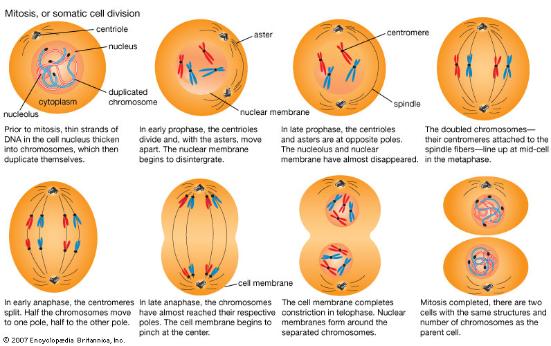
During your life, cells die and are replaced all the time. But where do the new cells come from? They are a product of mitosis, a process in which the somatic cells/ body cells and their genetic material are exactly copied. They undergo different phases in which the chromosomes are coiled up, copied, seperated and the cell plasma is seperated too. The result of mitosis are two diploid, identical daughter cells. Diseases that can be caused by a faulty mitosis is cancer.